From Fairway to Living System
Restoring the Ecology of Hilton Head Island’s Mid-Island Park
For decades, the landscape at the center of is now Mid-Island Park functioned as a golf course, a highly managed environment of fairways, isolated lagoons, channelized waterways, and maintained turf. Today, the Town of Hilton Head Island is envisioning a fundamentally different future for the nearly 100-acre Mid-Island Tract: one where ecological restoration becomes the framework for a new public park.
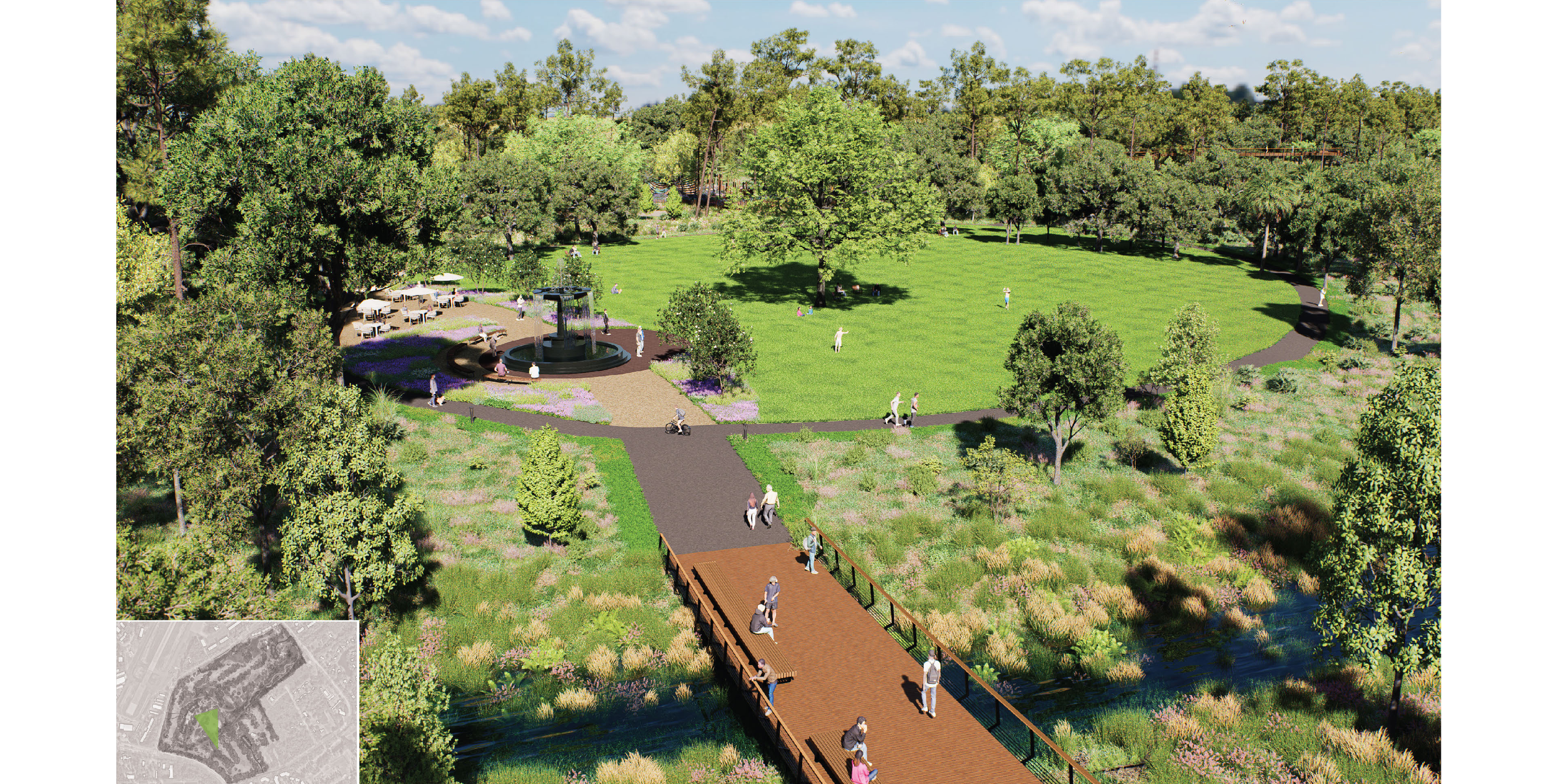
Mid-Island Park is designed not simply to add greenspace, but to repair the environmental systems beneath it. The plan transforms a manipulated landscape into one that more closely reflects the character and function of the Lowcountry, using hydrologic restoration, wetland creation, native plant communities, habitat enhancement, tree preservation, and material reuse to create a healthier and more resilient landscape.
The ecological work is not treated as something separate from the park experience. It is the park experience.
Letting Water Move Again
Water is one of the defining characteristics of the Lowcountry, but at Mid-Island, decades of modification have disrupted its natural movement.
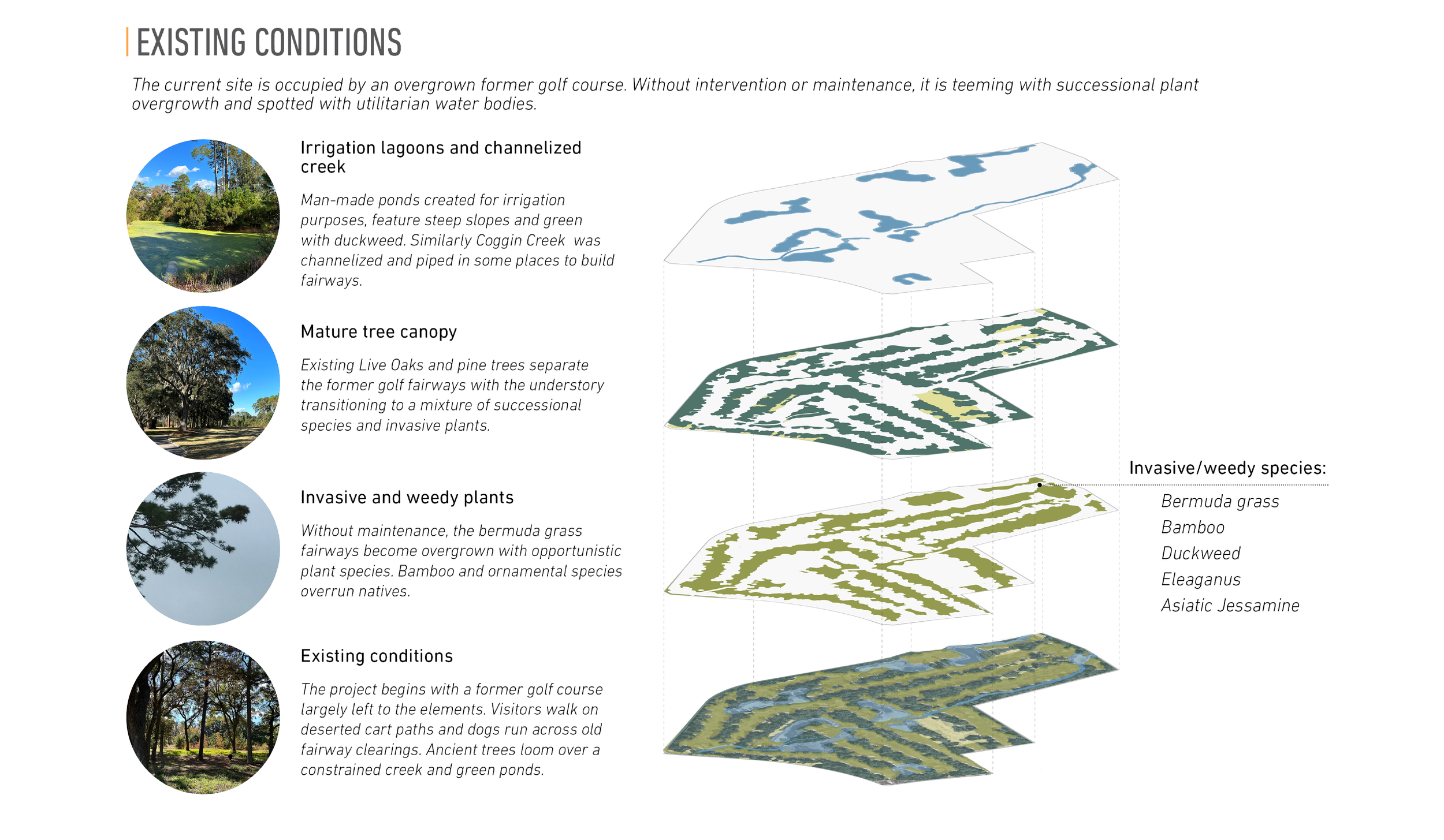
Existing man-made lagoons were separated from one another and connected primarily through pipes, limiting circulation and contributing to poor water quality and surface algal growth. At the same time, Coggin Creek, the natural drainage corridor carrying water through the property and from upstream areas, had been channelized, resulting in steep banks, erosion, a reduced floodplain, and diminished riparian habitat.
The park plan reverses that approach.
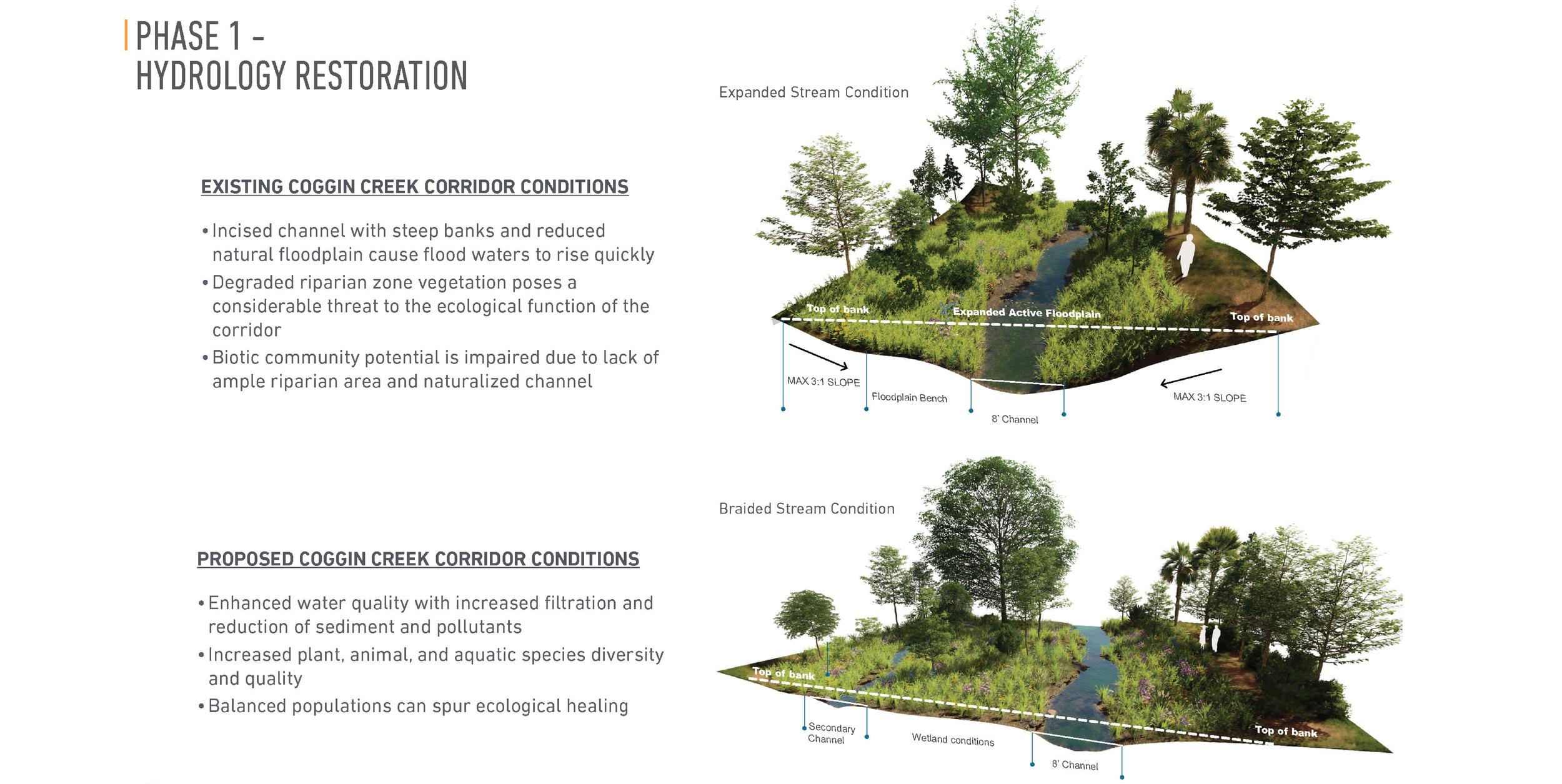
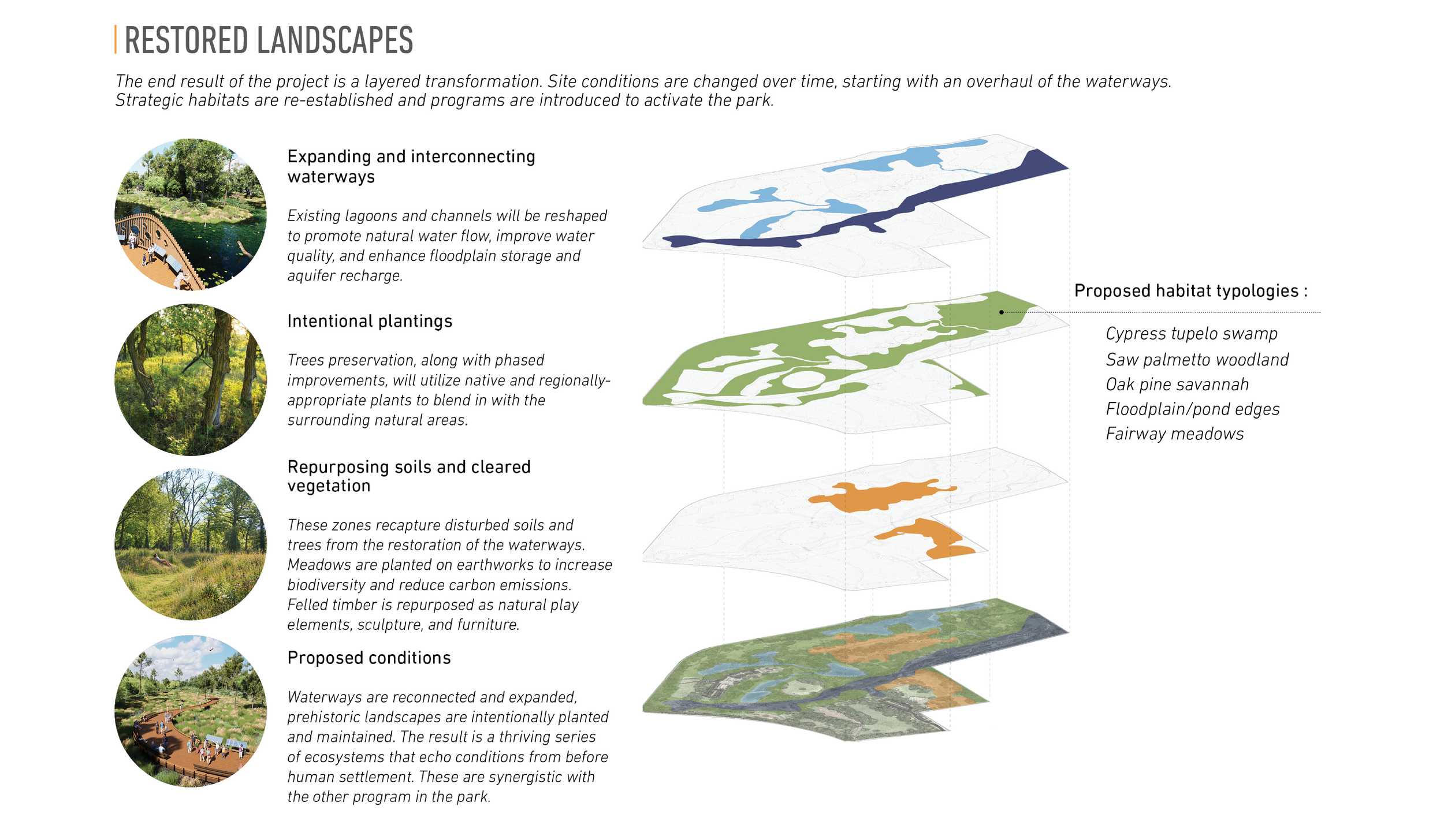
Rather than moving water away as quickly as possible, the landscape is designed to slow, spread, store, filter, and reconnect it. Lagoons will be reshaped and interconnected to increase natural flushing, while Coggin Creek will be expanded beyond its constrained channel to create a broader active floodplain, wetland shelves, and, in places, a braided stream condition.
The hydrology restoration diagrams illustrates the change clearly: an incised eight-foot channel with steep banks is transformed into a wider system incorporating floodplain benches, secondary channels, wetland conditions, and gentler slopes. The anticipated result is increased filtration, reduced sediment and pollutants, and improved habitat for plant, animal, and aquatic species.
This is landscape infrastructure performing multiple jobs at once.
Building Resilience Through the Floodplain
Restoring water systems also strengthens the park’s ability to respond to increasingly variable environmental conditions.
Strategic regrading is intended to increase the amount of stormwater the site can hold while reconnecting its waterways. By expanding active floodplain areas and giving water more room to move, the park can moderate stormwater flows rather than relying entirely on narrow channels and isolated ponds.
That additional storage also supports groundwater recharge. The project identifies recharge of the subgrade aquifer, a component of the Town’s water supply, as one of the benefits of restoring the site’s hydrologic function.
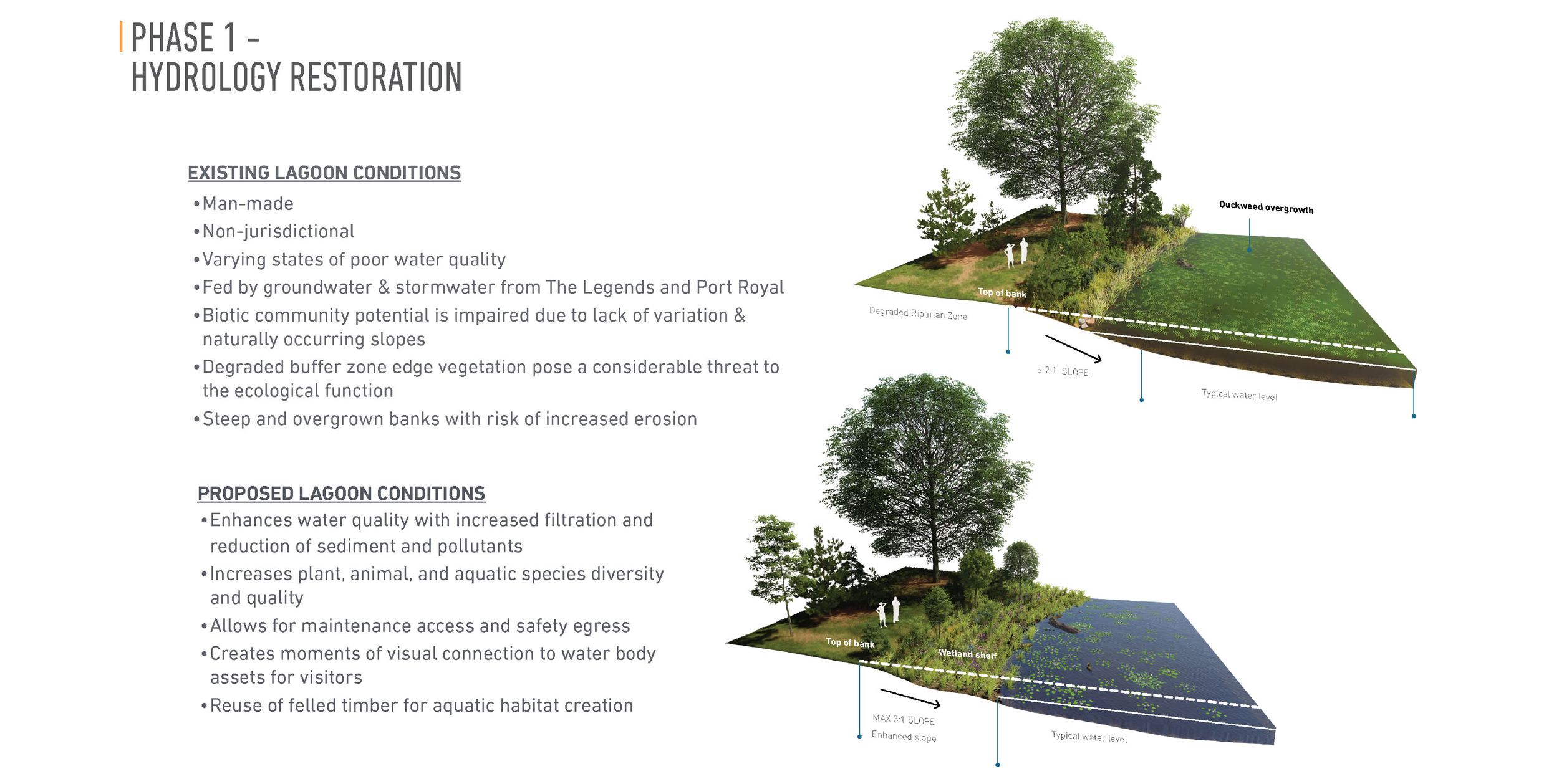
The proposed lagoon restoration follows the same principle. Existing lagoons have steep, overgrown banks, degraded buffer vegetation, limited habitat variation, and varying levels of poor water quality. The proposed condition introduces wetland shelves and enhanced slopes to increase filtration, reduce sediment and pollutants, diversify aquatic and terrestrial habitat, reduce erosion risk, and reconnect visitors visually with the water. Felled timber can even be reused within the lagoons to provide additional aquatic habitat.
Instead of concealing stormwater infrastructure, Mid-Island makes its ecological function visible.
From Monoculture to Biodiversity
The transformation of the former golf course extends well beyond its waterways.
Open fairways represent a simplified landscape. The park plan begins to break down those expanses through new landforms, meadows, native plant communities, selective planting, and natural succession.
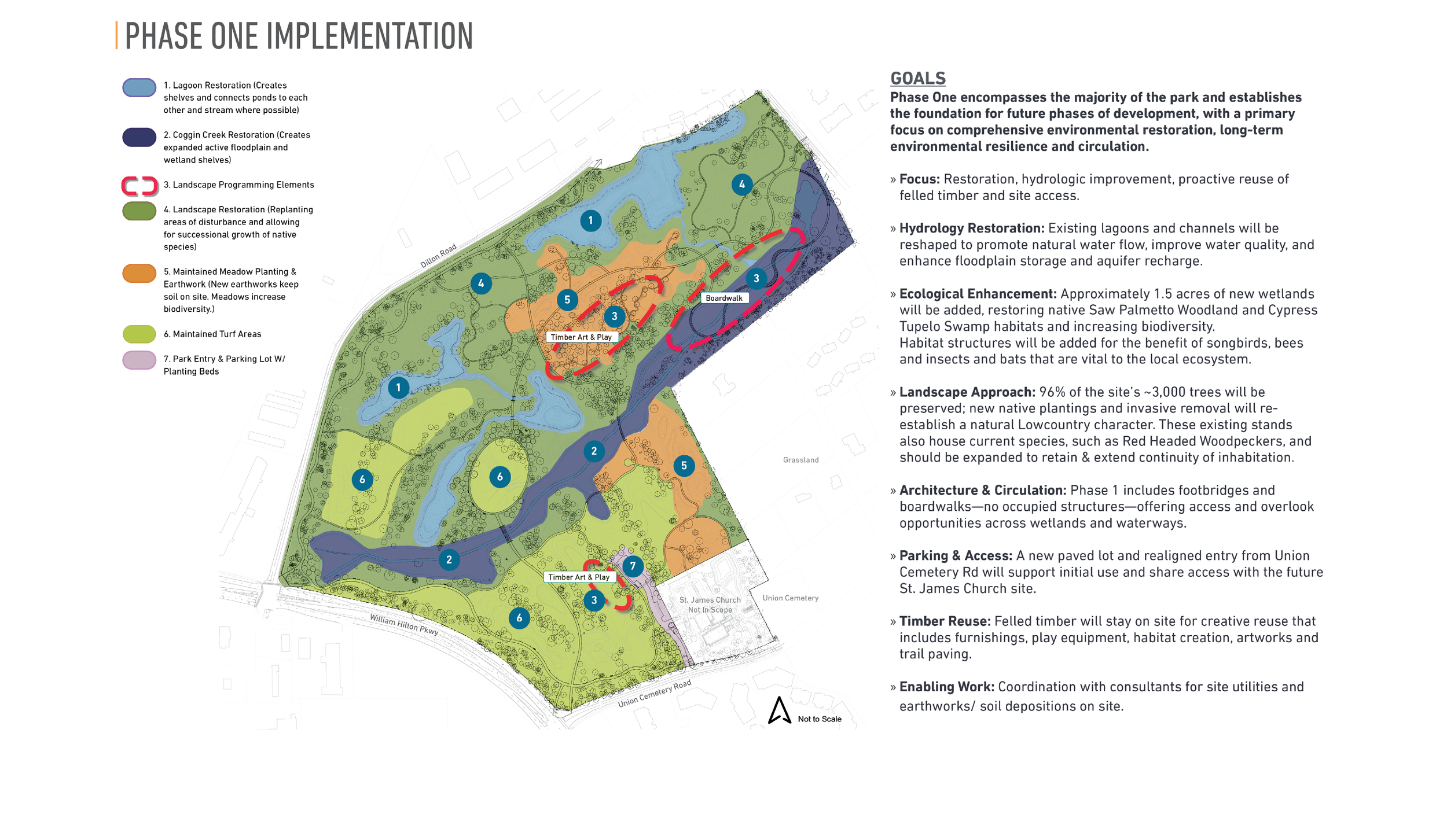
Approximately 1.5 acres of new wetlands are proposed, alongside the restoration and expansion of Lowcountry habitats including Saw Palmetto Woodland and Cypress Tupelo Swamp. Maintained meadow areas are intended to increase biodiversity, while disturbed areas will be replanted and allowed to develop through the successional growth of native species.
Future phases build upon that framework through supplemental pine flatwoods, pine-saw palmetto flatwoods, riparian slope, and pine-wiregrass woodland habitat establishment across multiple areas of the park. Invasive species removal is likewise embedded throughout the long-term phasing strategy rather than treated as a one-time intervention.
The result is intended to be a more layered landscape—one with greater variation in canopy, understory, meadow, wetland, shoreline, and aquatic conditions. That diversity creates more opportunities for wildlife while establishing a landscape that is recognizably of Hilton Head Island rather than a remnant of its former use.
Preserving the Ecology That Is Already There
Restoration does not mean starting over.
One of the project’s most consequential ecological strategies is preservation: 96 percent of the site’s approximately 3,000 existing trees are planned to remain. New native planting and invasive species removal will strengthen those existing stands while expanding habitat continuity across the property.
Those trees already support wildlife, including White-tailed Deer, rabbits, hawks, and Red-headed Woodpeckers identified on the site. The plan calls for preserving and extending existing habitat so that restoration builds upon established ecological communities rather than replacing them. Additional habitat structures are proposed for songbirds, bats, bees, and other insects that perform important functions within the local ecosystem.
In this sense, the project treats existing ecological value as capital, something to protect, connect, and amplify.
Keeping the Landscape in the Landscape
Even material that must be removed is considered part of the ecological system.
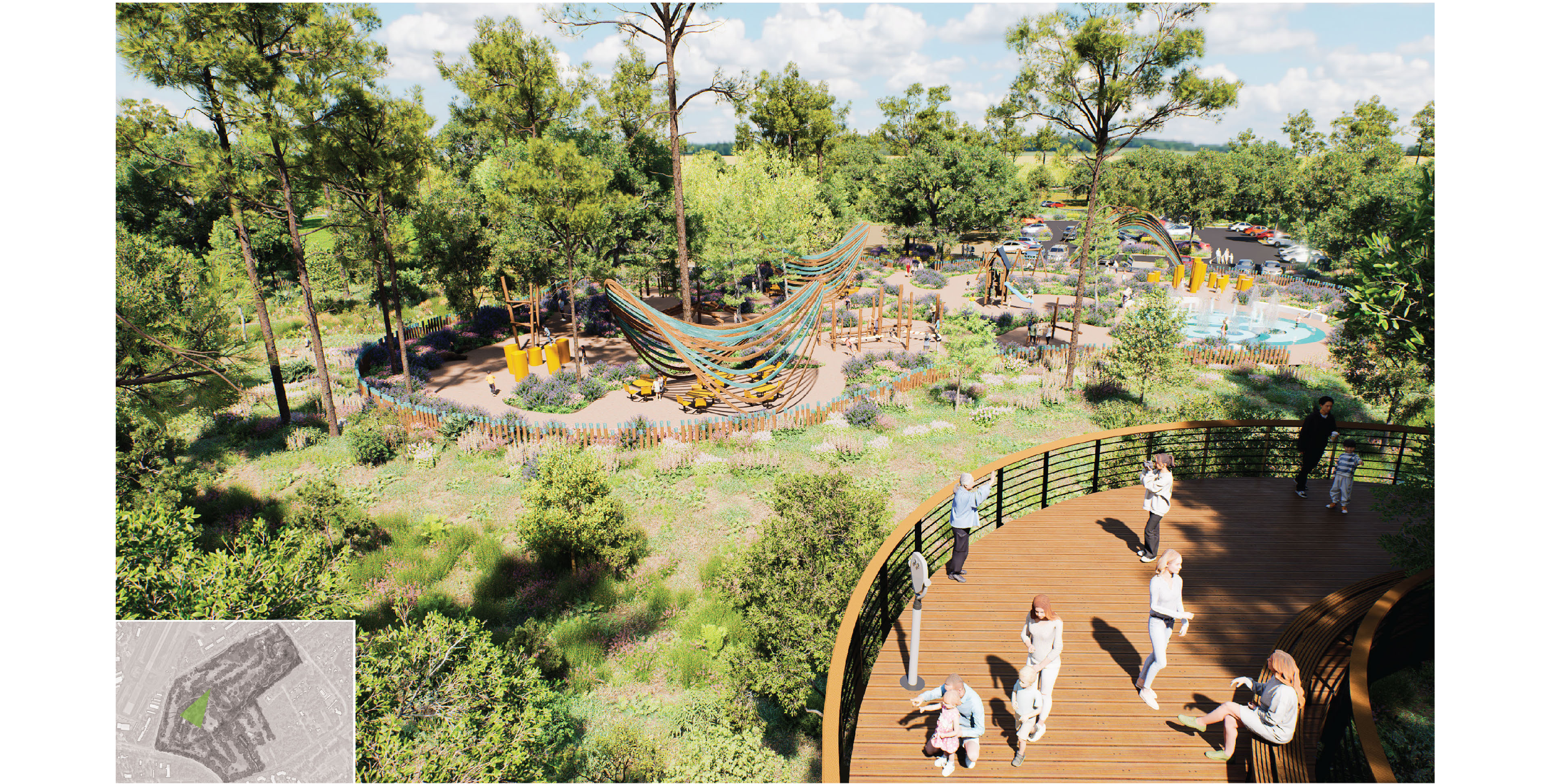
Instead of hauling felled trees away from the site, Phase One proposes keeping timber at Mid-Island and giving it new functions. Logs and wood can become benches, play elements, artworks, trail material, amphitheater seating, habitat structures, and aquatic habitat. Earthwork is similarly conceived to retain soil on site while reshaping the former golf course into a more diverse landscape.
It is a simple shift with larger implications: materials that might traditionally be classified as waste remain part of the site’s ecological and cultural story.
A fallen tree can become habitat.
A log can become a place to sit.
Soil excavated in one location can form a meadow or play landscape elsewhere.
The park’s construction process becomes part of its restoration strategy.
Making Ecology Accessible
Ecological restoration has the greatest public impact when people can experience and understand it.
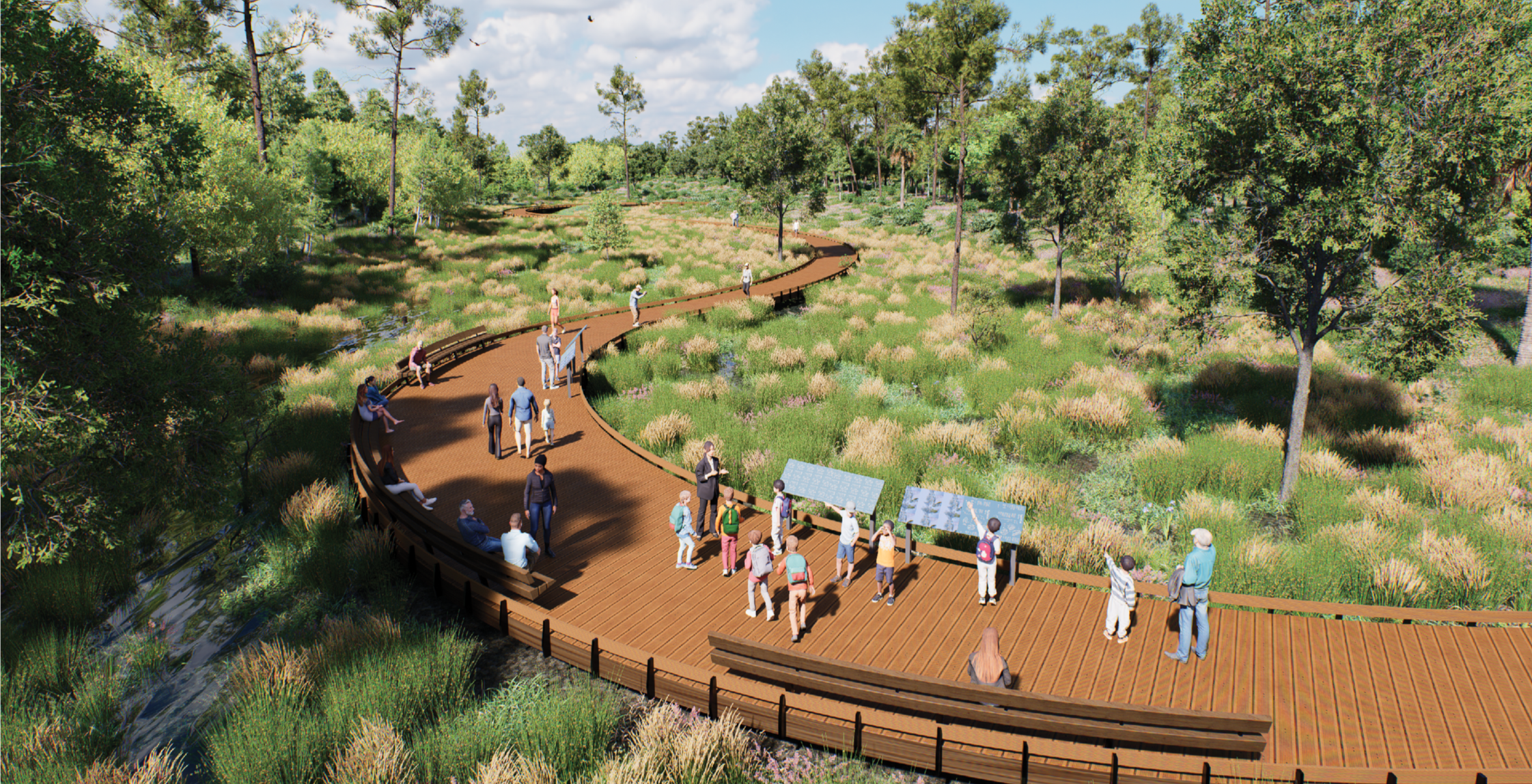
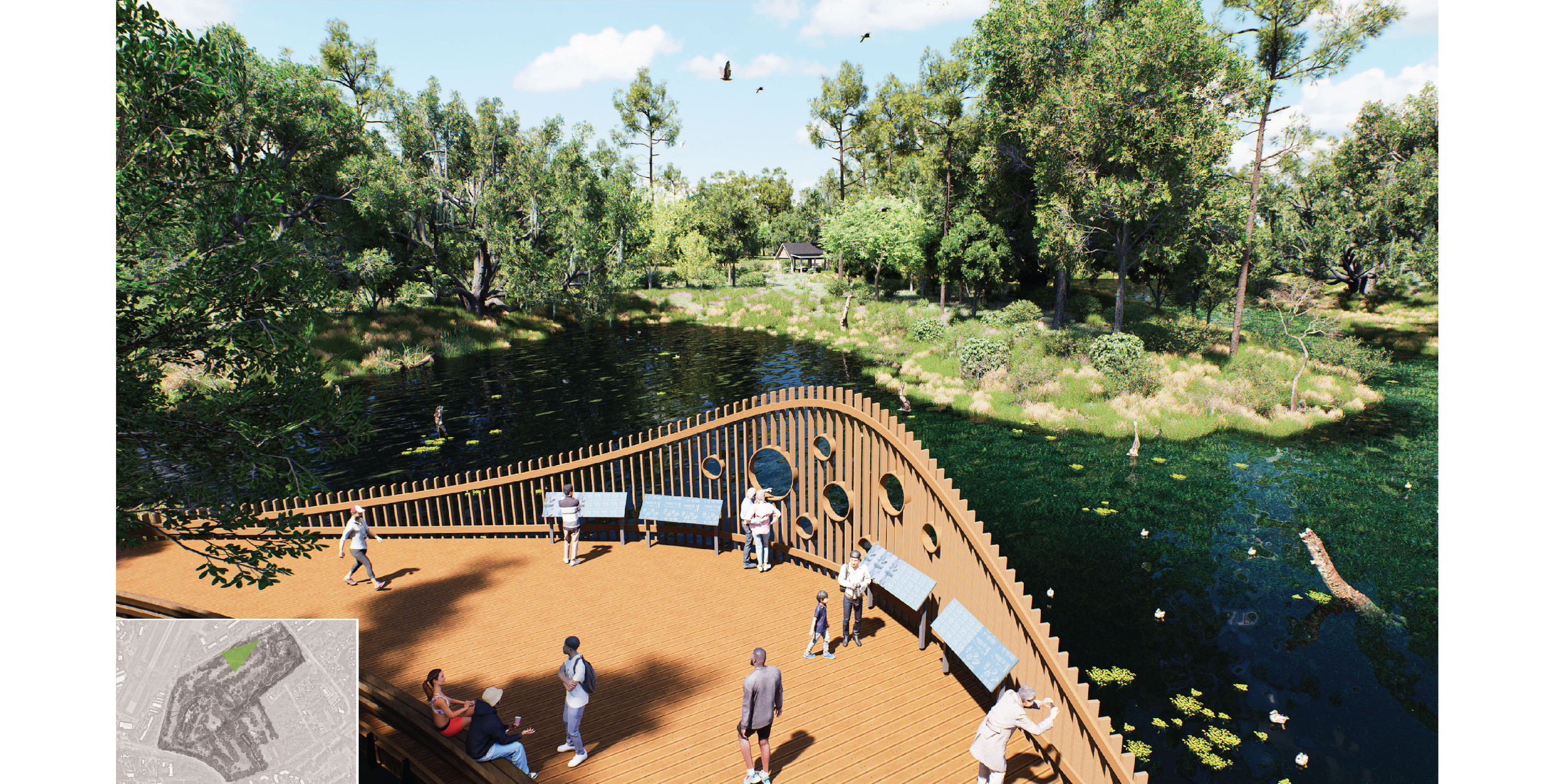
Mid-Island Park is designed to bring visitors into close contact with its restored systems without overwhelming them. Boardwalks will move through wetlands and alongside the newly braided stream corridor. Footbridges will cross waterways. Trails will weave through native landscapes. A bird blind will create opportunities for wildlife observation, while a future Eco Center and outdoor educational spaces could help interpret the hydrology, habitats, and environmental processes unfolding across the site.
This approach turns the park into a form of environmental education that does not require a classroom. A child crossing a wetland boardwalk, a birder overlooking a lagoon, or a family walking beside Coggin Creek can encounter ecological restoration as something tangible and alive.
The landscape demonstrates what healthy systems look like, and how they work.
Ecology as Civic Infrastructure
Mid-Island Park suggests a broader way of thinking about public landscapes.
Parks can provide recreation and gathering space while simultaneously managing stormwater, improving water quality, creating habitat, supporting biodiversity, preserving mature trees, recharging groundwater, and adapting to flooding. These are not competing objectives. At Mid-Island, they are deliberately interdependent.
That integrated approach is reflected in the project’s potential alignment with both the Sustainable SITES Initiative (SITES) and Waterfront Edge Design Guidelines (WEDG). The Executive Summary identifies connections to SITES criteria across hydrology, soils and vegetation, materials reuse, site context, human health and construction practices. Its WEDG-related strategies include greater floodplain capacity, interconnected lagoons, improved aquifer recharge, and boardwalks and bridges positioned above base flood elevation.
For Hilton Head Island, the ecological impact of Mid-Island Park could ultimately extend beyond its boundaries. Restored waterways connect to larger systems. Habitat supports species that move beyond property lines. Increased stormwater storage benefits downstream conditions. Native landscapes provide a visible model for how developed land can be reconsidered.
Most importantly, the project recognizes that ecological restoration is not about recreating an idealized past. It is about preparing a landscape for its next century.
By allowing water to move more naturally, preserving the canopy that has endured, rebuilding native habitat, increasing biodiversity, and inviting people into those restored systems, Mid-Island Park has the opportunity to transform a former golf course into something much more consequential: a living piece of Lowcountry infrastructure, designed to become healthier and more resilient with time.
About the Author:
Tony Roell, ASLA, PLA, LEED AP, is an Associate Principal and landscape architect at MKSK with more than 20 years of experience creating public spaces that respond to the environmental, cultural, and community character. His work includes parks, mixed-use districts, civic spaces, downtown revitalization, and campus environments, with an emphasis on integrating design, ecology, and long-term community value.
Tony has played a key landscape architecture role in the planning and design of Mid-Island Park on Hilton Head Island, the transformation of a former golf course into an approximately 100-acre public greenspace. Through projects such as Mid-Island Park, Tony brings a collaborative, site-responsive approach that seeks to make environmental performance integral to the visitor experience, creating landscapes that strengthen ecological systems while giving communities meaningful new ways to connect with place.